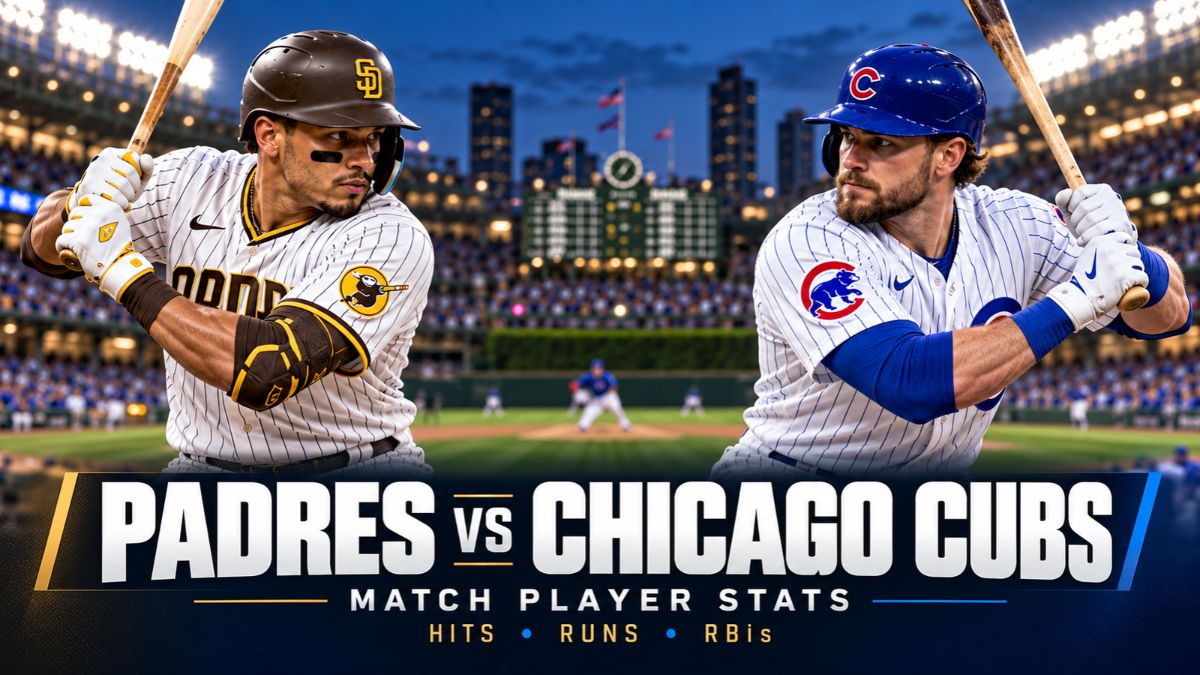
A final score tells you who won, but the batting lines show how the game took shape. This guide to Padres vs Chicago Cubs Match Player Stats covers San Diego’s 4–1 home win on September 30, 2026, in Game 2 of the National League Wild Card Series. You will find hits, runs and RBIs for every player who batted, along with the substitutes who only played defence. The review also explains the key scoring plays, pitching support and missed chances that help make sense of the numbers.
Match Date, Final Score and Team Totals
The game took place at Petco Park in San Diego. The Padres finished with four runs and eight hits, while the Cubs scored once on five hits. Neither team made an error. San Diego scored twice in the second inning and twice in the fourth. Chicago’s only run came in the fourth, leaving the home side with a three-run winning margin.
These Padres vs Chicago Cubs Match Player Stats refer to this single game. The Padres had 30 official at-bats and four RBIs. The Cubs had 31 at-bats and one RBI. Keeping the date beside the numbers matters because the teams have played many times. A batting line from another meeting, or a total from the full series, would tell a different story.
What Hits, Runs and RBIs Mean
Before comparing Padres vs Chicago Cubs Match Player Stats, it helps to understand the main batting columns. The hit column counts singles, doubles, triples and home runs. A run goes to the player who reaches home to score. RBI means run batted in, a credit given to a batter for certain plays that bring a run home.
At-bats and plate appearances are different. Walks, hit-by-pitches and sacrifice flies count as plate appearances but do not count as official at-bats. A batter can therefore help create a run without getting a hit. Read the hits, runs and RBI columns together, then check walks and scoring plays. That approach gives a fairer view than judging a player from the hit column alone.
Fernando Tatis Jr., Dustin Harris and Manny Machado
Fernando Tatis Jr. finished with no hits in four at-bats, no runs and no RBIs. Dustin Harris also went hitless in four at-bats, with no runs or RBIs. Manny Machado collected one hit in four at-bats. He did not score or drive in a run. Together, the first three hitters in San Diego’s starting order produced one hit in 12 at-bats.
That combined line shows why it is useful to examine the whole order. The Padres won despite getting little batting production from their first three spots. A familiar name does not always lead a particular game. When reviewing this result, start with what each player actually did rather than assuming that the best-known hitters supplied the winning offence.
Ty France, Jackson Merrill and Xander Bogaerts
Ty France had two hits in four at-bats, scored once and finished without an RBI. Jackson Merrill collected two hits in three at-bats, scored one run and had no RBIs. He also drew a walk. Xander Bogaerts went two-for-four, scored once and drove in one run. France and Bogaerts each hit a double, adding extra-base value to their batting lines.
This group stands out in the Padres vs Chicago Cubs Match Player Stats because it supplied six of San Diego’s eight hits. Their combined three runs also show how reaching base can support the hitters who follow. France and Merrill had no RBIs, yet both helped put runs on the board. For a useful comparison, give credit to the players who build a scoring chance as well as those who finish it.
Ethan Salas, Austin Hays and Jake Cronenworth
Ethan Salas had no hits in one official at-bat, scored no runs and earned one RBI. His sacrifice fly brought Merrill home in the second inning. Austin Hays went hitless in one at-bat, with no runs or RBIs. Jake Cronenworth finished with no hits in two at-bats, no runs and no RBIs. Cronenworth also reached base after being hit by a pitch.
Salas provides a clear example of why a hitless game can still include useful batting work. His fly ball produced an out, but it also allowed a runner to score. The RBI records that result. Looking only at his zero in the hit column would miss his contribution. The sacrifice-fly entry explains why he had more plate appearances than official at-bats.
Padres Pinch Hitters and Defensive Substitutes
Gavin Sheets made the strongest batting impact from San Diego’s bench. He had one hit in one at-bat, scored once and drove in two runs with a fourth-inning home run. Miguel Andujar went hitless in one at-bat, with no runs or RBIs. Samad Taylor also had no hits in one at-bat and finished without a run or RBI. All three entered as pinch hitters.
Padres Batting Summary
| Player | At-Bats | Hits | Runs | RBIs |
|---|---|---|---|---|
| Ty France | 4 | 2 | 1 | 0 |
| Jackson Merrill | 3 | 2 | 1 | 0 |
| Xander Bogaerts | 4 | 2 | 1 | 1 |
| Gavin Sheets | 1 | 1 | 1 | 2 |
| Ethan Salas | 1 | 0 | 0 | 1 |
Jase Bowen and Freddy Fermin appeared as defensive substitutes without batting. Both had zero at-bats, hits, runs and RBIs. Their entries belong in a complete review of Padres vs Chicago Cubs Match Player Stats, but they should be read differently from a hitless batting line. They had no chance at the plate. A zero-for-zero line describes that lack of batting opportunity, rather than a failed attempt to get a hit.
Pete Crow-Armstrong, Alex Bregman and Michael Busch
Pete Crow-Armstrong went hitless in four at-bats, with no runs and no RBIs. Alex Bregman had the same basic batting line, finishing zero-for-four without a run or RBI. Michael Busch had no hits in two official at-bats, no runs and no RBIs. Busch did draw a walk, which gave Chicago a baserunner without adding to his hit total.
Chicago’s first three starting hitters therefore combined for no hits in ten at-bats. This helps explain the limited scoring in the Padres vs Chicago Cubs Match Player Stats. Still, the walk deserves a place in the review. For any hitter, reaching base can create an opening even when the final batting line shows no hit, run or RBI.
Seiya Suzuki, Ian Happ and Nico Hoerner
Seiya Suzuki recorded one hit in four at-bats and scored Chicago’s only run. He finished with no RBIs. Ian Happ had no hits in three at-bats, no runs and no RBIs, but he drew a walk. Nico Hoerner led the Cubs with two hits in four at-bats and drove in their only run. Hoerner did not score, and one of his hits was a double.
Suzuki and Hoerner fill different roles in the Padres vs Chicago Cubs Match Player Stats. Suzuki reached base and later crossed home, while Hoerner supplied the hit that brought him in. Neither line explains the scoring play by itself. Read them together and the connection becomes clear. Happ’s walk also helped build that fourth-inning opportunity, even though he did not reach home.
Matt Shaw, Carson Kelly and Dansby Swanson
Matt Shaw finished with no hits in two at-bats, no runs and no RBIs. He also drew a walk. Carson Kelly had one hit in three at-bats and finished without a run or RBI. Kelly reached base another time when a pitch hit him. Dansby Swanson went hitless in three at-bats, with no runs scored and no runs driven in.
These lines show a difference between putting runners on base and bringing them home. Shaw and Kelly helped create chances, but neither scored. For readers comparing the lower part of each order, that distinction is useful. A walk or single can begin a promising inning. The next few hitters still need to turn that opening into a run before the inning ends.
Cubs Pinch Hitters and Defensive Changes
Tyrone Taylor entered as a pinch hitter and singled in his only at-bat. He finished with one hit, no runs and no RBIs. Michael Conforto also came off the bench to bat, but he struck out in his only at-bat. Conforto recorded no hits, runs or RBIs. Pedro Ramírez entered on defence and had no at-bats, hits, runs or RBIs.
Cubs Batting Summary
| Player | At-Bats | Hits | Runs | RBIs |
|---|---|---|---|---|
| Nico Hoerner | 4 | 2 | 0 | 1 |
| Seiya Suzuki | 4 | 1 | 1 | 0 |
| Carson Kelly | 3 | 1 | 0 | 0 |
| Tyrone Taylor | 1 | 1 | 0 | 0 |
Taylor’s single gave the Cubs a useful bench contribution, although it did not lead to a run. His one-for-one line should also be kept in context. One successful at-bat is a good result for that appearance, but it offers little evidence about a player’s longer-term form. Compare bench players by both their results and their opportunities, since a substitute may bat only once.
How the Scoring Plays Changed the Game
San Diego’s second-inning scoring began with a double from France. Merrill followed with a single, and Bogaerts then singled to bring France home. Salas added the sacrifice fly that scored Merrill. That sequence combined an extra-base hit, singles and an out that still produced a run. It shows why several different batting actions can contribute to the same successful inning.
Chicago answered in the fourth when Hoerner singled to score Suzuki, cutting the gap to 2–1. In the bottom half, Sheets hit his two-run homer with Bogaerts on base, making it 4–1. In this review, that home run is the clearest turning point in the scoring. It restored breathing room for San Diego immediately after Chicago had moved within one run.
Pitching Support Behind the Batting Numbers
Nick Pivetta started for San Diego and allowed one run across three and one-third innings. Bradgley Rodriguez followed with one and two-thirds scoreless innings. Jason Adam, Adrian Morejon and Mason Miller then completed the game without allowing another run. Rodriguez received the win, and Miller earned the save. Together, the five Padres pitchers held Chicago to five hits and struck out eight batters.
Kevin Gausman allowed three runs in three and one-third innings for Chicago. Daniel Palencia gave up the other run, while David Peterson and Ryan Zeferjahn had scoreless outings. Pitching belongs beside the Padres vs Chicago Cubs Match Player Stats because it explains the challenge each batting order faced. Chicago’s hitters needed to recover against a bullpen that kept the score unchanged through the final five innings.
Runners in Scoring Position and Missed Chances
The Padres went three-for-six with runners in scoring position, while the Cubs finished one-for-eight. San Diego left five runners on base, compared with seven for Chicago. These figures show that the difference involved the timing of hits as well as the total number. The Cubs put runners in useful positions but converted fewer of those batting opportunities into hits.
Runners on second or third are described as being in scoring position. When reading Padres vs Chicago Cubs Match Player Stats, check this category after the basic batting totals. It helps connect the individual lines to the score. However, one game’s results do not prove that a team will always succeed or struggle in those situations. Use the figures to explain this match, then look at a larger sample for wider conclusions.
How to Read the Batting Lines Correctly
A practical way to use Padres vs Chicago Cubs Match Player Stats is to begin with at-bats and hits, then add runs, RBIs and walks. After that, check the scoring sequence. This order helps answer three separate questions: who reached base, who scored and who brought runners home. It also stops one eye-catching number from becoming the whole explanation of a player’s performance.
Check what period a displayed batting average covers before comparing it with a game’s hit total. A box score may show a series or season average beside single-game figures. Also, keep substitutes separate from starters when comparing opportunities. Someone with one at-bat had a different workload from someone with four. Use the full batting line and the game context to make a balanced judgement.
Conclusion
The Padres vs Chicago Cubs Match Player Stats show how San Diego combined hits from the middle of its order, a productive sacrifice fly and a major bench contribution. Chicago received useful batting work from Hoerner but could not turn enough chances into runs. Reading every batter’s hits, runs and RBIs alongside the scoring plays gives a clear picture of this 4–1 game.
(FAQ’s)
1. Which game does this article cover?
It covers the September 30, 2026 Wild Card game at Petco Park, which San Diego won 4–1.
2. Who had the most hits for the Padres?
Ty France, Jackson Merrill and Xander Bogaerts tied with two hits each.
3. Who led the Cubs in hits and RBIs?
Nico Hoerner led Chicago with two hits and one RBI.
4. Who hit the game’s only home run?
Gavin Sheets hit a two-run home run for San Diego in the fourth inning.
5. How did Ethan Salas earn an RBI without a hit?
His sacrifice fly allowed Jackson Merrill to score from third base.
You may also read: San Antonio Spurs vs New Orleans Pelicans Match Player Stats and Top Scorers on Both Teams
Visit for more additional information: Loom Magazine