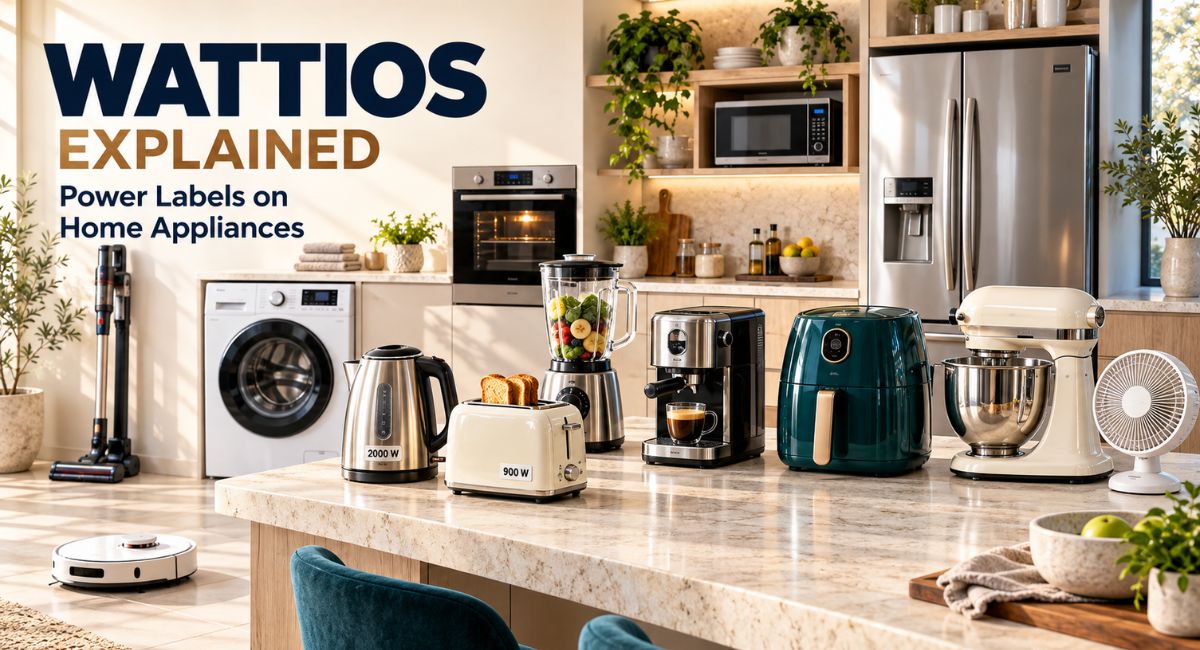
A kettle may show 2,000 W on its base, while a fan shows only 60 W. Does that mean the kettle always costs more to run? Not necessarily, because time matters too. If you searched for Wattios while trying to understand these numbers, the place to start is the appliance label. Those small letters and figures can help you understand power use, compare products, and estimate running costs. You just need to know what each number tells you and what it leaves out.
What Does Wattios Mean?
Wattios is linked to a historical Spanish spelling of the word for watts. The Royal Spanish Academy records this spelling in its historical entry for “vatio,” the modern Spanish term. In English, the standard word is “watt,” and its symbol is W. On an appliance, look for W or kW when checking electrical power. The number beside this symbol helps you understand the power rating for that particular product.
A watt measures how quickly energy is being used or transferred. A device drawing 100 W uses energy at a higher rate than one drawing 20 W. However, that number alone does not tell you the daily cost. You also need the operating time and your electricity price. Think of Wattios as a starting point for understanding watts, then use the units printed on your appliance for any calculations.
Where to Find the Power Label
The electrical rating label is often on the back, bottom, or side of an appliance. On some products, it sits near the power cable or inside a door opening. It may include the model number, voltage, frequency, and power rating. This small label has a different purpose from the large energy sticker displayed on appliances in shops. One describes electrical details, while the other helps you compare energy performance.
Start by finding the model number and the figure beside W or kW. A clear phone photo can make tiny text easier to read. If the label is hidden or damaged, check the instruction booklet or the manufacturer’s product page for that exact model. Avoid using figures from a similar-looking product. Two appliances with almost identical names can have different sizes, motors, or heating elements, which can change their power requirements.
What W, V, A, and Hz Mean
The letters on a power label describe different things. W means watts, the unit of power. V means volts and describes voltage, which helps push electric current through a circuit. A means amperes, usually called amps, which measure current. Hz means hertz and describes the frequency of an alternating current supply. These details help explain the electrical supply the appliance is designed to use, so they should be read together.
A marking of 230 V does not mean an appliance uses 230 W. Likewise, a current rating in amps is not an energy figure for your bill. When checking running costs, look for the input power in watts. Multiplying volts by amps does not always give the exact wattage for alternating current devices. If watts are missing, the manufacturer’s specifications or a suitable power meter can provide a more useful answer.
Watts and Kilowatt-Hours Are Different
Watts describe power at a particular moment. Kilowatt-hours, written as kWh, describe energy used over time. One kilowatt equals 1,000 watts. A device drawing 1 kW steadily for one hour uses 1 kWh of electricity. This difference explains why an appliance label and an electricity bill often show different units. The label describes the appliance’s power rating, while the bill usually charges for the energy your home has used.
For a simple example, imagine a lamp that draws 10 W for five hours. It uses 50 watt-hours, or 0.05 kWh. Leave it on for ten hours, and that amount doubles. The lamp’s power stays the same, but its energy use increases with time. Understanding Wattios becomes much more useful once you separate these ideas, especially when comparing something used briefly with something left running throughout the day.
Why Rated Power Is Not Always Actual Power
The wattage on a label is a rated figure, sometimes a maximum, rather than a live measurement. Read the wording beside it to understand what it describes. Actual power can change with the setting, workload, and stage of operation. A fan may draw different amounts at different speeds. A washing machine may need more power while heating water than during other parts of the wash. One printed number cannot describe every moment.
A fridge also changes its power use as it keeps food cool. Some compressors switch on and off, while inverter models can adjust their speed. Multiplying a fridge’s rated wattage by all 24 hours can therefore produce a poor estimate. Annual energy figures or measurements taken over several normal days are usually more helpful. For any appliance with changing power use, an average reading gives a clearer picture than a brief peak.
How to Calculate Daily and Monthly Running Costs
For an appliance drawing steady power, use this calculation: watts multiplied by hours, divided by 1,000, equals kWh. Then multiply the kWh by your electricity price per kWh. Suppose a fan draws 60 W for eight hours each day. It uses 0.48 kWh daily. Over 30 days, that becomes 14.4 kWh. At an example rate of £0.30 per kWh, the energy cost would be £4.32 for that period.
These figures are only an example, so replace them with your own readings, operating hours, and electricity rate. Fixed charges and other bill items are separate from this simple calculation. If your supplier charges different prices at different times, use the rate for the hours involved. A useful running-cost calculation also needs realistic operating time. Count active use accurately, and remember that devices with changing power need an average figure or a measured kWh total.
Why Running Time Changes the Cost
A large wattage figure can look worrying, but a short period of use may involve little energy. Imagine a kettle drawing 2,000 W for a total of six minutes. Six minutes is one-tenth of an hour, so its energy use would be 0.2 kWh. Now imagine a router drawing 15 W continuously for 24 hours. It would use 0.36 kWh, even though its power rating is much lower.
This comparison is an example, not a statement about every kettle or router. It shows why daily habits belong beside label readings. When reviewing your home, consider both high-power appliances and devices that run for many hours. A rarely used kitchen appliance may contribute less than expected. A modest load running every day can become more noticeable over a month. Compare energy over the same period to make the numbers useful.
Check Input Power and Output Power Carefully
Some products show both input and output power. Input is the electrical power taken from the supply. Output describes power delivered by the device, such as microwave cooking power or a charger’s electrical output. These figures can differ, so check which one you are reading. When estimating electricity taken from a wall socket, input power is the relevant figure. Using output power instead can make your estimate too low.
For a real example, Samsung lists its MS23K3513AK/SM microwave with 800 W of microwave output and 1,150 W of power consumption. Those numbers describe different parts of its operation. Similarly, the wattage advertised for a phone charger usually describes its output capacity, rather than a constant draw from the socket. Read the full label and product details before calculating costs. This is particularly useful when a large number on the packaging differs from the smaller electrical label.
How Energy Labels Help You Compare Appliances
An energy label adds information that the electrical rating plate cannot provide alone. Depending on the product and country, it may show annual energy consumption, energy per cycle, or an efficiency rating. For example, EU washing machine labels show energy use per 100 cycles based on the eco 40–60 programme. Refrigerator labels commonly show annual kWh. Always read the time period or number of cycles beside the figure before comparing two products.
Suppose a washing machine label shows 50 kWh per 100 cycles. That works out to an average of 0.5 kWh per cycle under the stated test conditions. It does not mean every programme uses exactly that amount. Hotter settings, different loads, and other choices can change consumption. Use these labels to compare similar products under the same testing system. Reading power ratings alongside energy labels gives you a fuller picture than wattage alone.
Why Lower Wattage Does Not Always Mean Better Value
Choosing the smallest wattage does not automatically give you the most efficient appliance. Efficiency also depends on how much useful work the device does. With light bulbs, compare brightness in lumens as well as watts. If two bulbs provide the same light output, the one using fewer watts is more efficient at producing that light. A dimmer bulb with lower power is not a fair comparison if it cannot meet your needs.
For larger appliances, compare suitable capacity, energy consumption, and purchase price together. A small washing machine may use less energy per cycle but require more loads for your household. Estimated running costs on labels are useful comparisons, although your actual spending depends on local electricity prices and use. Before buying, check whether the product suits the job you need it to do. An attractive power figure should support that decision rather than make it for you.
Measuring Real Use With an Energy Monitor
A suitable plug-in energy monitor can show what an appliance actually draws from a socket. Models with energy tracking can also record kWh over time. This helps when a label is unclear or power changes during use. Check that the monitor is suitable for your socket, supply voltage, and appliance load. Follow its instructions, and do not assume that every smart plug includes an energy-measuring feature. Check the product description first.
Measure a complete normal task, such as a full wash, rather than checking only one moment. For a fridge, several typical days are more informative than a quick reading. Record the settings and operating time so later comparisons are fair. If you enter your electricity rate into the monitor, keep that rate current. Measuring power this way helps turn a rough estimate into evidence about your own appliance and daily habits.
Turn Label Readings Into Useful Changes
Once you understand the figures, choose a few changes based on how your home works. Standby power deserves attention because some devices still use electricity while appearing to be off. A screen, clock, or network connection may remain active. Check a product’s standby information or measure it where possible. Avoid assuming that all devices have the same standby draw. The useful question is how much energy a particular device uses during those idle hours.
You can also compare appliance settings while keeping the result useful. Try an appropriate eco programme, wash full loads within the machine’s limit, and turn off lights in empty rooms. Record what changes, then compare the energy used over similar tasks or periods. Keep essential equipment operating as intended. Start with one or two appliances you use often, rather than replacing products before checking whether different settings or shorter operating times would meet your needs.
Conclusion
Wattios makes more sense when you connect it with watts, operating time, and the units on an appliance label. Begin with the correct model and input power, then check how the appliance works during normal use. Use kWh to estimate energy consumption and your own electricity rate to work out costs. Energy labels and suitable monitors can help fill the gaps. Together, these details make it easier to compare appliances and choose changes that fit your home.
(FAQ’s)
1. Is Wattios the Standard Word on Appliance Labels?
The standard English unit is watt, usually shown as W; Wattios is linked to a historical Spanish spelling.
2. Does a 1,000 W Appliance Always Use 1 kWh?
It uses 1 kWh if it draws 1,000 W continuously for one hour.
3. Can I Calculate Running Costs From Watts Alone?
No, you also need operating time and your electricity price per kWh.
4. Why Does My Fridge Use Less Power Than Its Label Suggests?
Its power demand changes as the compressor switches on and off or adjusts speed.
5. Should I Compare Input or Output Power for Electricity Costs?
Use electrical input power, or measured kWh, to estimate electricity taken from the supply.
You may also read: How to Use Kouskousi in Your Soups Without Making Them Too Thick
Visit for more additional information: Loom Magazine