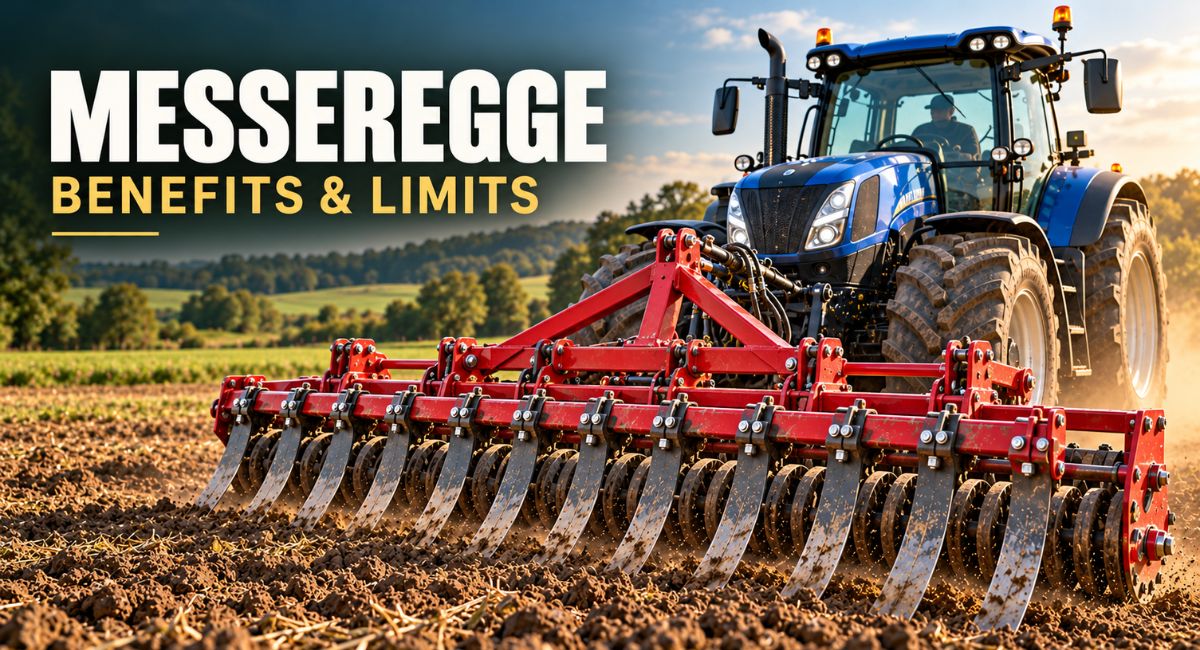
A field can look ready for planting while hard clods, damp patches, and uneven ground still cause problems. Choosing the right finishing tool can help, but using it at the wrong time may create more work. A Messeregge is a soil-working implement with knife-like parts, often used as an attachment in a larger soil preparation system. Its main value is helping break soil clods. Before taking one into the field, it helps to understand what the attachment does, which benefits depend on the complete machine, and when another approach makes more sense.
What Is a Messeregge and How Does It Work?
The name comes from German farming language and is often described in English as a knife harrow. However, the name alone does not tell you everything about a machine. Blade shape, spacing, mounting position, and adjustment options can differ. On some equipment, the attachment works ahead of a packer roller, which firms the soil after the front tool has worked it.
Keep those jobs separate when comparing equipment. Breaking clods is different from pressing loose soil back together. A roller may provide the firming action, while the front attachment works on lumps. Ask to see the exact model and its working parts. This gives you a clearer picture than assuming that every feature of the complete machine belongs to the blades.
Smaller Clods Can Support Better Seed Placement
Large, hard lumps can leave gaps around seeds and make planting depth less even. A Messeregge may help reduce these clods when the soil is in a suitable condition. This can make the next planting operation easier. The useful result is a seedbed with a workable structure, rather than a surface that simply looks smooth from the tractor seat.
For example, imagine a prepared field with scattered lumps along the planned seed rows. After a short test pass, check whether those lumps have broken into smaller pieces. Then inspect the soil where seeds will sit. Better contact between seed and soil can support more even emergence, but the crop still needs enough moisture, suitable temperatures, and correct planting depth.
Combined Equipment May Reduce Separate Field Jobs
A Messeregge fitted to a suitable packer system can form part of a combined soil preparation operation. The front attachment breaks clods while the roller performs its own finishing work. When this combination replaces a separate job that the field actually needs, there may be a chance to reduce working time and tractor travel.
Treat those savings as something to check on your farm. Compare the planned operation with your current method, including fuel, labour, and the finished seedbed. A wider or heavier setup may cost more to operate. If you still need the same extra passes afterwards, the expected saving may disappear. For example, replacing two separate finishing jobs with one suitable combination is different from adding another machine pass to an already complete routine. The useful comparison is the total cost of getting the field ready to plant.
Shallow Working Requires Careful Adjustment
One reason to consider a Messeregge is its role in shallow soil preparation. Some models offer working depth adjustment, allowing the operator to match the tool to the task. However, adjustment systems vary. Use the instructions for the actual equipment instead of copying a depth, blade setting, or forward speed from a different machine.
More soil movement is not always better. Repeated working can break stable soil crumbs into fine material and leave the surface more likely to crust after rain. A crust can make it harder for seedlings to emerge. Aim to solve the visible seedbed problem with limited disturbance. Once the required result is reached, another pass needs a clear reason.
Wet Soil Can Limit the Benefits
Using a Messeregge on soil that is too wet can leave a poor result, even when the machine continues moving without blocking. Wet ground may smear around the working parts, while tractor traffic can press the soil together. A machine’s ability to travel through a damp field does not prove that the soil is ready to be worked.
Check several places, including low patches and headlands where tractors turn. Look beneath the dry-looking surface, because the working layer may still be sticky. Soil that smears easily or behaves like soft putty is a reason to pause and assess conditions. Waiting can be more useful than trying to repair a damaged seedbed through repeated passes later.
Dry Ground Creates Different Problems
Very dry ground can also make soil preparation difficult. Hard clods may resist breaking, while lighter soil can become dusty after repeated working. Tillage can increase moisture loss from the worked layer. A smooth finish is less useful if the soil around the seed becomes too dry for reliable germination.
Before another pass, check the moisture at the planned planting depth. Think about how soon planting will follow and whether the weather is becoming hotter or windier. Avoid assuming that shallow work always saves water. The result depends on the disturbance, remaining crop cover, soil type, and weather. Sometimes leaving an acceptable seedbed alone is the better decision.
Deep Compaction Needs a Separate Check
A Messeregge should not be treated as a general answer to deep compaction. Its shallow working action cannot be assumed to loosen a dense layer below its reach. The surface may look improved while roots still face a hard layer underneath. This is why appearance alone is a weak way to judge whether a field problem has been solved.
If crops repeatedly struggle in wheel tracks or roots turn sideways at a similar depth, investigate further. Digging a small inspection pit can help reveal the soil layers and root pattern. Compaction, drainage, and natural soil differences may require different responses. Get local advice before choosing deeper treatment, and review the traffic or wet conditions that may be causing repeated damage.
Weed Control and Residue Handling Have Limits
Do not buy a Messeregge on the assumption that it will remove every weed or chop heavy crop remains. Its usefulness depends on the working parts and the task they were designed to perform. A tool intended to break clods may not provide the cutting, clearance, or soil mixing needed for another job.
Look closely at the field before choosing an attachment. Thick straw bands, long stalks, or well-established weeds deserve attention during a demonstration. Ask the seller to explain how that model handles them and watch the result. Keep a separate weed and residue plan where needed. Also remember that crop remains protect the surface, so removing or burying everything is not automatically an improvement.
Soil Type and Slope Change the Decision
The same setup can behave differently across one farm. Clay-rich soil may remain wet after a lighter field becomes workable. Sandy soil may be loose enough without much additional preparation. Hand checks can help, but their meaning changes with soil texture. Soil that forms a ball is not equally wet or equally workable in every field.
On slopes, consider how much soil will move and how much protective cover will remain. Extra passes can increase soil movement and leave ground more exposed to erosion. Do not chase the same finish everywhere simply because it looks tidy. Judge each field by its crop needs, moisture, slope, and existing structure, then decide whether the proposed operation is worthwhile.
Match the Complete Setup to Your Tractor
Before choosing a Messeregge, check how the attachment fits into the full equipment setup. Working width is only one part of the decision. The tractor must suit the complete machine’s weight, mounting arrangement, and operating requirements. If a front-mounted packer is involved, lifting capacity, axle loads, visibility, and balance all need to be checked against the relevant instructions.
Ask the supplier to confirm compatibility with your tractor and any equipment used at the same time. Avoid choosing a model from engine power alone. Also consider field entrances, storage space, and movement between fields. A combination that looks useful in a demonstration may be awkward on your farm if access is narrow or the tractor cannot handle it properly.
Use a Short Test Strip Before Full Fieldwork
Start with a short, representative strip rather than committing to the whole field. Follow the approved setup procedure, make a pass, and stop safely to inspect the result. With a Messeregge, look for useful clod reduction without excessive dust, smearing, or uneven soil movement. Check across the working width, because one side may perform differently from the other.
Change only one permitted setting at a time, then compare the results. For example, keep speed steady while checking a depth adjustment. Record what changed and whether it helped. Where practical, leave an untreated strip for comparison and inspect the crop after emergence. Use similar ground and the same planting method, so the comparison has meaning. A wet hollow beside a dry hilltop will tell you little about the tool alone. This helps you judge whether the operation improved planting conditions, rather than relying only on the immediate appearance.
Include Wear and Maintenance in the Cost
Purchase price does not show the full cost of ownership. Working parts wear, replacements take time to fit, and damaged components can interrupt a busy planting period. Before buying, ask about spare parts, service support, and the recommended inspection schedule. For used equipment, check the frame and mounting points as well as the blades. Ask which parts are included in the quoted price and whether worn components need immediate replacement. A low purchase price is less helpful if repairs are needed before the first field operation.
Follow the machine’s maintenance instructions and make it safe before checking underneath or clearing material. Support raised equipment as required, stop the tractor, and release stored pressure where instructed. Keep a simple record of repair costs, working time, and area covered. Divide the total operating cost by the area worked to compare cost per hectare across different options. These figures make future comparisons more useful and help show whether keeping, hiring, or replacing the equipment offers better value.
Recognise When Another Approach Fits Better
Sometimes the field needs a different tool, and sometimes it needs no further cultivation. A tine harrow, disc implement, or another finishing system may suit a particular task better. These tools do different amounts and types of soil movement. Compare them against the problem you need to solve, rather than expecting them to produce identical results.
If the seedbed already suits the crop and planting equipment, an extra operation may add cost without a useful benefit. Farms using direct drilling or reduced tillage should also consider whether another full-width pass fits their system. A demonstration on similar soil can help clarify the choice. The right decision is the one that prepares the crop well while avoiding unnecessary work.
Conclusion
A Messeregge can be useful where clod reduction is needed before planting, especially as part of a suitable packer setup. Its value depends on soil condition, correct adjustment, tractor compatibility, and the work it replaces. Wet ground, very dry conditions, deep compaction, and demanding residue problems can limit the result. Inspect the field first, test a short strip, and judge the soil at planting depth. Use the equipment when it solves a clear problem, then stop once the seedbed is suitable.
(FAQ’s)
1. What is a Messeregge mainly used for?
It is used for soil preparation, particularly breaking clods. Its exact role depends on the model and equipment combination.
2. Can a knife harrow fix deep compaction?
Do not assume so. A shallow attachment cannot loosen a dense layer below its working depth.
3. Does using this attachment always save fuel?
No. Savings depend on whether it replaces other work and how much power the complete setup needs.
4. Is a smooth surface proof of a good seedbed?
No. Check soil structure, moisture, and conditions at the intended planting depth as well.
5. Should the tool be used before every crop?
No. Use it when the field needs its working action and conditions are suitable.
You may also read: CVHATG Search Tips for Finding Clear Answers and Useful Sources
Visit for more additional information: Loom Magazine