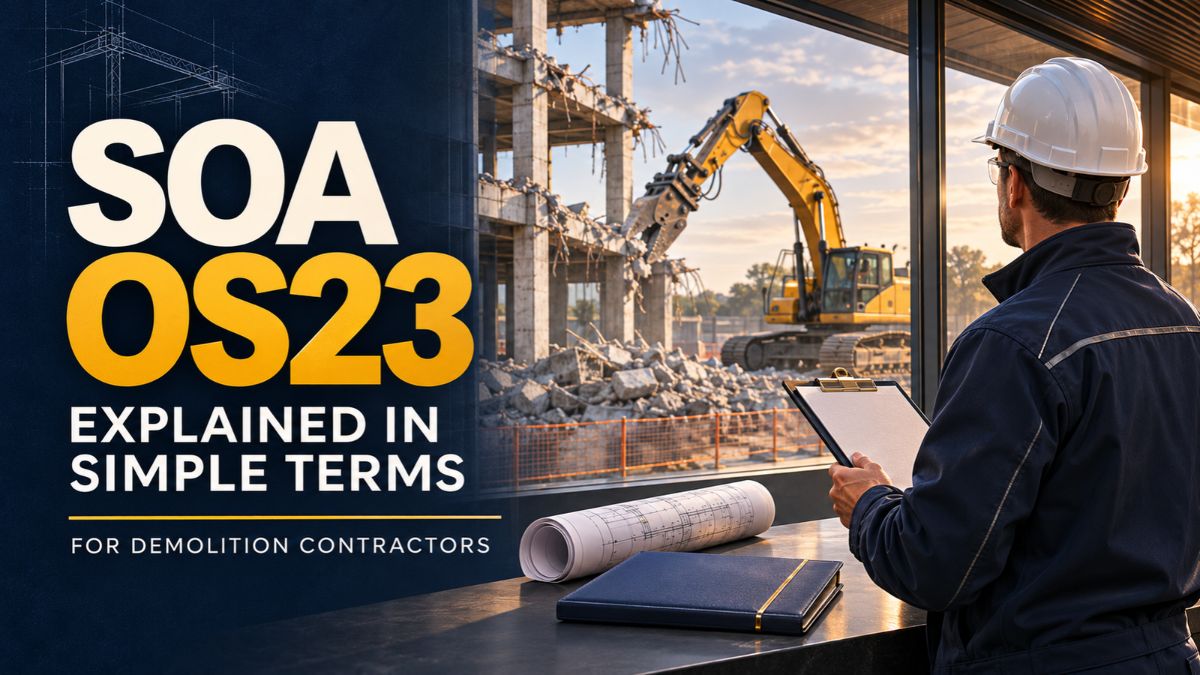
A demolition company may have skilled workers and the right machines, yet still struggle to enter a public tender. The missing piece may be proof of qualification. In Italy, SOA OS23 identifies a company’s qualification for a specialist category of demolition work. Understanding it can help you choose suitable contracts, prepare better records, and plan your next business step. This guide explains what the category covers, how the assessment works, and what to check before applying. It also explains how this qualification relates to other duties on a demolition project.
What Is SOA OS23?
SOA refers to the authorised bodies that assess construction companies for Italy’s public works qualification system. These bodies check evidence about a business before issuing an attestation, which is the formal qualification document. OS23 is the specialist category for demolition work. Together, the terms describe a company’s assessed qualification in that category. The certificate belongs to the company named on it, so it should be checked against the business that will carry out the contract.
In simple terms, SOA OS23 helps show that a company meets the qualification requirements for the stated demolition category and amount class. It gives public clients a standard way to check certain business capabilities. However, gaining the document does not mean that a company will win a tender. Price, the proposed work, the award rules, and other participation conditions still matter. Contractors should therefore treat qualification as one part of preparing for public work.
Which Demolition Jobs Does It Cover?
The category covers demolition activities such as taking down buildings, dismantling industrial installations, and cutting reinforced concrete structures. Its official description also includes collecting demolition materials, separating them, and their possible recycling in the building materials industry. The scope refers to several methods, including special equipment and explosives. Mentioning a method within the category does not give a contractor separate permission to use it without meeting the relevant requirements.
For example, removing an old concrete building or dismantling an industrial structure may involve work within this category. However, a project description can include several different activities. Demolition, ground preparation, environmental cleanup, and new construction may need separate consideration. Read the schedule of works rather than relying on the project title. Ask for clarification when a tender groups several tasks together and the required qualification is unclear.
When Do Demolition Contractors Need It?
For Italian public works contracts worth €150,000 or more, the procurement code generally requires contractors to hold the appropriate qualification. The category and amount class must match the work being awarded. This does not mean every demolition company needs the same certificate for every job. The contract value, the activities involved, and the company’s role all need to be checked against the tender conditions and current rules.
A contractor considering SOA OS23 should start with the kinds of projects it hopes to undertake. Read a few suitable tender notices and compare their requirements with your existing records. For smaller public jobs, qualification requirements still exist, even where the same attestation route is not required. Private contracts also need their own checks. Avoid using one public tender as a guide to every future contract, because the work and participation arrangements may differ.
How Do Categories and Amount Classes Work?
A category describes the type of work, while a class describes the financial level of qualification. These details appear together on an attestation. For example, Class I has a base limit of €258,000, while Class II has a base limit of €516,000. The rules can allow a one-fifth increase under the relevant conditions. This means you should check the full qualification rules rather than treating a base figure as the only consideration.
When planning an application, choose a class that fits both your evidence and your business goals. Applying for a higher level without enough support may create extra work and disappointment. Equally, a lower class may not suit the contracts you want. Discuss your target project range with the assessment body before committing to an application. A realistic choice can help you plan costs and understand which tenders deserve your time.
What Does the Qualification Body Check?
The assessment covers general eligibility and the company’s financial, technical, and organisational capacity. Relevant areas include business registration, tax and social contribution compliance, financial information, equipment, staff, and technical direction. The assessor also examines relevant work experience. These checks help establish whether the business meets the conditions for its requested qualification. Owning a powerful excavator or employing experienced operators is useful, but neither proves the full set of requirements on its own.
Before you apply, bring your accountant and technical manager into the discussion. They may hold different parts of the evidence, and their figures should tell the same story. For instance, equipment records should connect clearly with the accounts and supporting contracts. Ask the assessment body which quality management certification requirements apply to your requested class. Early questions are easier to handle than discovering a missing requirement when the application is already under review.
Which Documents Should You Prepare?
An application for SOA OS23 needs clear, verifiable evidence. Depending on the assessment, this can include company records, financial statements, staff information, equipment documents, technical director details, and evidence of completed work. Get a current document request from your chosen assessment body. The exact material depends on the company’s legal form, its history, and the qualification requested. A checklist copied from another business may leave out something important to your own application.
Create one working folder and give each document a clear name. Use the project name, document type, and date where helpful. Check that company names, registration details, and financial periods agree across the files. Keep a simple record of what you have supplied and what is still missing. You should also decide who will answer requests from the assessor. This reduces the chance of two employees sending different versions of the same document.
Why Are Past Project Records Important?
Completed work is a key part of showing relevant experience. In Italy, certificates of work execution are often called CEL documents. The correct evidence matters, and invoices alone do not replace the required work certificates. Private projects can also be relevant when they meet the applicable documentation rules. Ask the assessment body how each project should be supported before assuming that its full value will count towards your qualification.
Imagine that your company completed a contract involving both demolition and rebuilding. Keep records that clearly describe the work performed and its value. A vague description such as “general building services” may make the history harder to assess. At the end of future jobs, request the appropriate completion documents promptly. It is usually easier to resolve missing details while the client, project manager, and accounts team can still locate the records easily.
How Does the Application Process Work?
Start by choosing an assessment body authorised by Italy’s public procurement authority. Discuss the category, class, and evidence you intend to submit. The formal process involves a contract with the body, followed by document checks and verification. The assessor may request explanations or additional material. A positive assessment leads to the issue of the attestation. Paying a fee starts a professional assessment process, rather than guaranteeing that the application will succeed.
During an SOA OS23 application, reply to requests with complete and consistent information. If a record is unavailable, explain the problem and ask what evidence can properly address it. Do not change project descriptions simply to make them appear more suitable. Keep copies of the submitted documents and important correspondence. Once the attestation is issued, check the company details, category, class, and dates carefully so that any error can be raised promptly.
What Does SOA OS23 Cost?
There is no single price that suits every company. Assessment fees are linked to a regulated tariff system, with factors including the requested categories and amount classes. Before signing, ask for a written quotation showing the scope of the service. Confirm how taxes, later changes, and future reviews will be handled. This gives you a clearer view of the commitment than an advertised starting price without any explanation of what it includes.
Your internal preparation also has a cost in staff time. An accountant may need to review figures, while an employee may need to recover old project files. If you use an outside adviser, ask how that service relates to the authorised body’s assessment. Compare quotations for the same requested qualification. A lower figure is only useful when you understand the service, the conditions, and any additional work your company must arrange.
How Long Does the Assessment Take?
The process involves more than sending a form and waiting for a certificate. The assessment body must review evidence and carry out the required checks. Missing records, unclear project values, or unanswered questions can affect the timetable. There are formal procedural time limits, but these should not be treated as a promise that every company will receive a positive result by a particular date. Ask how they apply to your case.
Begin preparing before a suitable tender reaches its final submission stage. Work backwards from your business goals and allow time to collect evidence from other people. A former client may not provide a missing record immediately. Ask the assessor which documents deserve attention first and when updates will be available. Keep your tender planning separate from hoped-for approval dates, and confirm that the necessary qualification is effective when the procurement rules require it.
How Long Is the Qualification Valid?
An SOA attestation normally lasts five years, with an intermediate check after three years to confirm that the relevant requirements are maintained. This means SOA OS23 needs attention during its lifetime. The three-year review and the later renewal are different stages. Missing a required review can affect the ability to participate in tenders. Contact the assessment body in advance to understand the correct timing and the documents needed for each stage.
Record the important dates as soon as the certificate arrives. Give one person responsibility for checking them and another person access to the same information. Keep financial and company records organised between reviews instead of rebuilding the file from the beginning each time. Discuss changes to ownership, technical direction, or other relevant business details with the assessment body. The aim is to keep the qualification record aligned with the company’s current position.
How Does It Differ From Other Construction Categories?
SOA OS23 concerns specialist demolition work. OG1, by comparison, concerns civil and industrial buildings, including construction and related activities within its defined scope. These categories should not be treated as interchangeable labels. A contractor may hold more than one category when its experience and resources support the necessary requirements. The category needed for a particular contract depends on the work and the way it is classified in the procurement documents.
Consider a project that removes an old warehouse and builds a replacement. A business experienced in general building work should read how the demolition element has been identified. The tender may contain more than one category and explain the required participation arrangements. If a partner or subcontractor is involved, check those arrangements before preparing the offer. A clear understanding of responsibilities helps avoid spending time on a bid that the proposed team cannot support.
What About Site Safety and Waste Handling?
Qualification does not replace project safety planning. Italian demolition safety rules address matters such as checking structural conditions and planning the order of demolition. The work programme must be reflected in the contractor’s operational safety plan, known as the POS. Each site needs its own assessment and suitable professional input. A company should connect its proposed method, people, and equipment with the actual conditions, rather than reuse a plan without checking its suitability.
Waste activities also have separate requirements. The environmental register has distinct categories for activities such as waste transport and asbestos removal. A demolition qualification does not automatically provide those registrations. Before pricing a job, establish who will carry out each waste activity and what authorisations are needed. Check the materials expected, the proposed transport arrangements, and the receiving facilities. Clear responsibilities can help prevent gaps between the demolition contract and the waste services it depends on.
How Can You Check a Contractor’s Qualification?
For a company claiming SOA OS23, examine the current attestation and compare it with the business details on the proposed contract. Check the category, amount class, issuing body, and relevant dates. Italy’s public procurement authority provides a public search service for qualification attestations. Use the company’s exact legal identity when searching. A trading name on a website may be less useful than the registered name and tax identification details.
Do not rely only on a logo or a certificate image in an old company brochure. Ask for current information and investigate any mismatch before moving forward. If the work includes several activities, compare each requirement with the proposed delivery arrangements. Keep a dated record of your checks alongside the project file. This is useful when different people review the supplier, prepare the contract, and later manage the work on site.
Which Mistakes Can Delay an Application?
A common preparation problem is choosing a target class before reviewing the evidence. Another is leaving all document collection until a tender becomes urgent. Businesses can also lose time when accounts, project descriptions, and company details do not agree. Check these areas early and ask the assessor to explain unclear requests. A short internal review can help reveal missing records before they become part of a larger exchange of questions.
New businesses should be especially careful about assuming that staff experience automatically counts as company experience. Different qualification routes have specific conditions, so obtain an assessment of your actual circumstances. Established companies should also review how acquisitions, ownership changes, or changes in technical direction affect their records. Build the application around evidence that can be checked. Promises of quick approval are less useful than a clear explanation of what your company can properly demonstrate.
A Practical Example for a Growing Demolition Company
Imagine a small Italian contractor that wants to move from private projects into public demolition work. Its first useful step is to review several suitable tenders and identify their category and class requirements. The company can then compare those requirements with its completed projects, financial records, equipment, and staffing. This example is a planning exercise, rather than a promise that a particular number of machines or completed jobs will secure qualification.
The owner asks an authorised assessment body to review the proposed application. During preparation, the team discovers that two older projects need better completion records. It contacts the relevant parties, organises the evidence, and asks for a written fee quotation. Meanwhile, the business checks whether the public work it wants is commercially sensible. Qualification can support growth, but the company still needs enough people, funding, and project capacity to deliver any contract it wins.
Conclusion
SOA OS23 is an important qualification category for demolition contractors entering the relevant Italian public works market. A useful starting point is to understand the work covered, choose a suitable class, and organise clear evidence of business capacity and past projects. Plan for assessment costs, review dates, and the separate requirements of each site. With careful preparation and realistic business goals, contractors can approach the process with fewer uncertainties and make better decisions about the tenders they pursue.
(FAQ’s)
1. What does OS23 mean in Italian construction?
It is the specialist work category for demolition and related activities within its official scope.
2. Who issues the qualification document?
An SOA body authorised by Italy’s public procurement authority issues it after assessing the company.
3. Does the certificate guarantee a public contract?
No, the company must still meet the tender conditions and compete under its award rules.
4. Can private demolition projects support an application?
They may count when they meet the relevant experience and documentation requirements.
5. Does demolition qualification cover asbestos removal?
It does not replace the separate environmental registration and other requirements for asbestos work.
You may also read: Onlyworkmoods com Review What to Expect From Its Work Articles
Visit for more additional information: Loom Magazine